
.png)
Articles from HR experts
HR is the real accelerator of AI adoption: what Allianz, PwC, and Nestlé are doing
February 24, 2026
7 minutes
HR is the real accelerator of AI adoption: what Allianz, PwC, and Nestlé are doing
Let’s begin.
There’s a paradox that isn’t talked about enough in the HR world.
And it has to do with AI.
When we talk about AI adoption in companies (Ethan Mollick, 2025), several people think that it’s just a matter of technology.
But that’s not the case.
Meaning, the technology must be there (of course).
But very often the main issue concerns the organizational adoption of AI (and therefore people).
And who is responsible for people?
Exactly: HR.
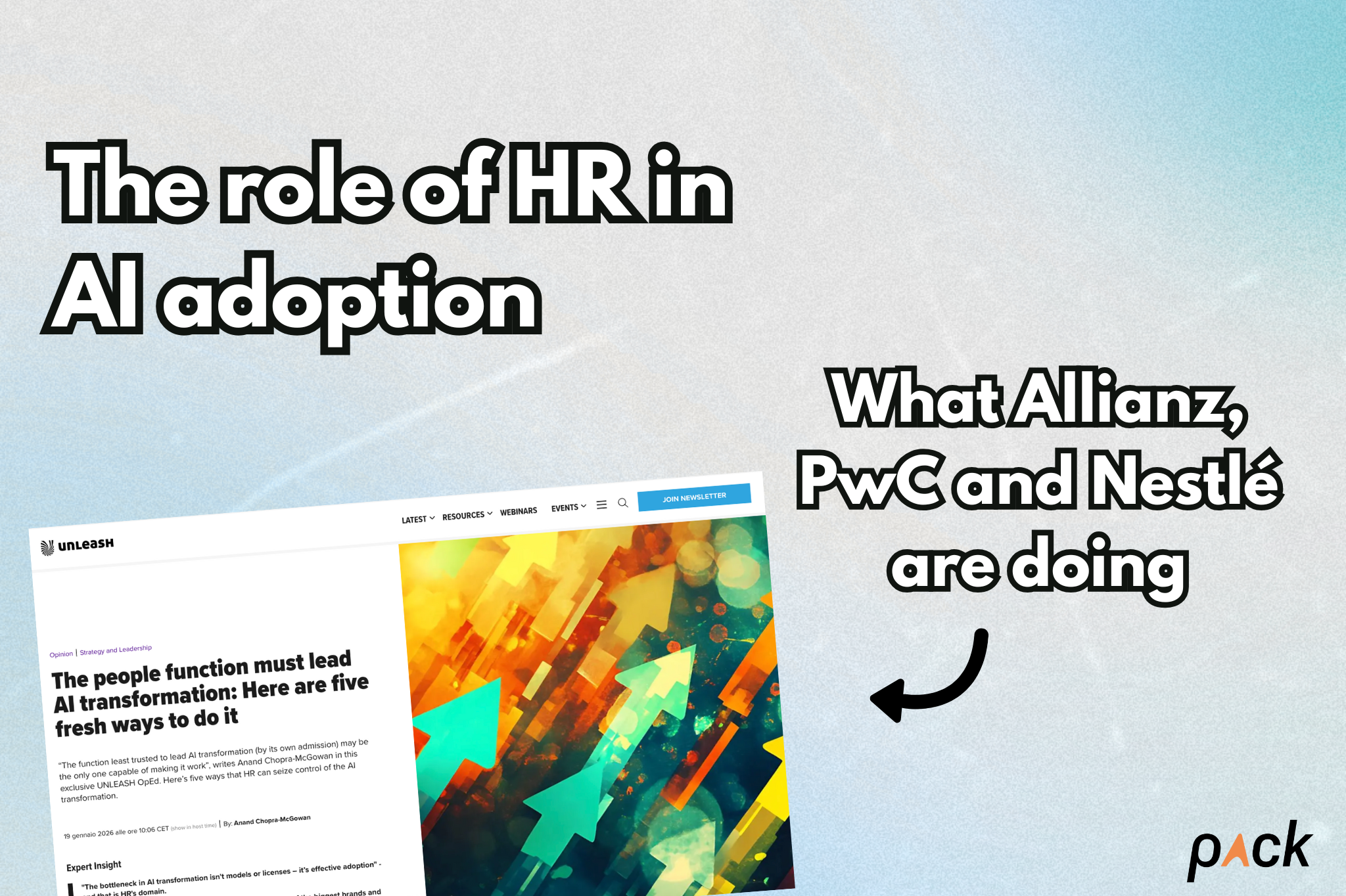
Despite this, only 30% of HR leaders believe their CEO considers them suitable to lead the AI transformation. (Unleash, 2026)

Yet they are the only ones truly capable of scaling adoption across the entire organization.
If you think about it, in recent months (now years), there has been a lot of talk about AI.
But what else has been talked about?
About how it could “replace people.”
For this reason, people are worried and show greater resistance to adoption.
Because they are afraid they “might fall behind.”
HR leaders, therefore, play a fundamental role in the success of AI adoption because they:
- understand how people and organizations learn
- understand the incentives that drive behavior
We’re sharing a series of concrete examples of how some HR leaders at large companies have acted in recent months.
In our opinion, they’re extremely valuable and could be a great starting point for your company too.
CASE 1
Making AI a universal skill: the Allianz case
Under the leadership of Global Head of Learning & Skills Management, Isabelle Kokoschka Levasseur, Allianz has:
- Included generative AI skills as a mandatory requirement in job descriptions
- Created practical micro-learning modules like “Reduce your heavy 4 hours” to eliminate inefficient tasks
- Some leaders ask “Did you use AI?” at the end of every meeting
These “small” changes have turned AI into a daily habit, not a one-off course that people take once and then forget.

CASE 2
Creating internal talent marketplaces: the Atlas Copco case
At the Swedish manufacturing group Atlas Copco, CHRO Cecilia Sandberg is launching a “skills-based talent transformation.”
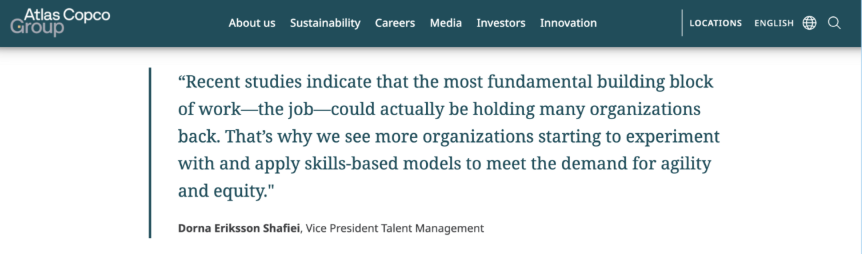
Here we want to dive deeper into the concept, because we think it’s important to explain it well.
So, with AI, no one knows for sure: WHEN certain jobs will change or disappear, HOW exactly they will change, and WHICH new jobs will emerge.
Let us give you an example: today you have 50 people doing data entry, but in 6 months AI could perform that work. What do you do? Lay them off? Reskill them? But for what roles?
Let's change scenario: let's say you need a Marketing Manager.
The traditional solution (which no longer works) is 👉 you need a “Marketing Manager,” you post a job opening with that title, look for someone who HAS BEEN a Marketing Manager, and hire externally, or promote someone with “that role.”
But this system has several limits:
- it’s rigid (if the role changes, you have to start over)
- you miss hidden talent (you might already have someone internally who would be an excellent marketing manager)
- it’s slow (posting, screening, hiring…)
- it’s expensive (external recruiters, onboarding)
So what is Atlas Copco doing? 🤔
Let's continue with our example.
Let’s assume you have a role-based system (the traditional one) and you’re looking for a “Marketing Manager” with 5 years of experience in that role and a degree in marketing.
The skill-based system turns this logic on its head.
With a skills-based system, instead, you look for these skills: data analysis, strategic thinking, digital marketing, budget management, and team leadership.
Okay… but what actually changes in practice when moving from a role-based system to a skills-based system?
Quite a few things, actually…
1) Talent acquisition
Before: “Have you ever worked as a Marketing Manager?” 👉 No 👉 Rejected
After: “Do you have these 5 skills?” 👉 You might discover that an internal person with experience in product management has those skills, and other highly valuable ones for that role or for the company and you don't need to look outside.
2) Internal mobility
Before: You’re a “Data Analyst” 👉 You want to move to “Product Manager” 👉 HR says: “You don’t have experience as a Product Manager”
After: You’re a “Data Analyst” 👉 You have the required skills 👉 HR says: “You’re just missing one skill, take a 3-month course and we’ll move you”
And this has huge advantages:
- (To pick up the previous example) if AI eliminates 100 positions for roles like data entry
- You already have the SKILLS of those 100 people mapped
- The system automatically finds which other internal roles those people can fill with their current skills
- You quickly reskill them only on the missing skills
- You move them internally instead of laying them off and hiring new people
3) Learning & Development (training)
Before: generic “Leadership” course 👉 You don’t know if it’s really needed and you might be wasting time and money.
After: You know EXACTLY what skills each person has 👉 You know EXACTLY what skills are needed for each role 👉 You train ONLY on the specific gaps 👉 You deliver targeted training with optimized budgets.
Not to mention that employee engagement increases and people feel more valued and appreciated.

They no longer end up with the classic course they’re “forced” to take, but instead follow a course designed specifically for them.
According to Cecilia Sandberg, however, for this system to work HR CANNOT work alone, it must constantly engage with:
- Business unit leaders: “What skills will you need in 6 months?”
- Line managers: “What skills do you see in your teams that aren’t on CVs?”
- CEO/CFO: “Here’s how the internal talent marketplace reduces costs and increases agility.”
- Employees: “Here’s how you can grow internally even if you don’t have ‘the right job title.’”

If this collaboration happens, the system becomes a strategic tool for the entire company.
At first, it may seem difficult to implement, but trust us, once it’s in place, it brings a huge number of benefits.
We are collaborating with several companies precisely to help them with this type of change, because they've understood the advantages they can gain from it.
Maybe in the next episodes we'll also tell you about a concrete case of one of our collaborations. 😊
Let’s say this kind of work is the PERFECT preparation for an AI-driven world for several reasons:
👉 Scenario 1: AI eliminates a role. The system immediately identifies where to move those people.
👉 Scenario 2: AI creates a new role. The system finds people who already have 70% of the required skills instead of hiring from scratch.
👉 Scenario 3: AI changes an existing role. The system identifies skill gaps and organizes targeted training.
CASE 3
Becoming a teaching organization: the PwC US case
At PwC US, a concern emerged about new hires (especially young people in their first work experience).
If you think about it, before AI, juniors learned fundamental skills from “boring” tasks: writing emails, preparing reports…
Now AI can handle these kinds of tasks, and for juniors it becomes harder to develop those basic skills.
Margaret Burke (Head of Talent at PwC US) observed that promotion timelines were in fact getting longer. People were taking more time to become good enough to be promoted.
And their solution to this problem was to become a teaching organization. (which put like that doesn't seem like anything new 😂).
But now we’ll explain it to you.
They said: “Okay, if juniors no longer learn ‘from boring tasks,’ we need to teach INTENTIONALLY.”
So they created a system across 75,000 employees based on 5 mandatory rituals:
- They established training moments between seniors and juniors
- They created spaces where asking seniors questions is encouraged
- They built a knowledge base made up of documentation and best practices
- They created a continuous, two-way feedback system
And to make this system work, they integrated it concretely with: performance evaluations, feedback programs, internal surveys, and recognition programs.
In this way, the 75,000 employees continue to develop critical skills even as AI automates formative tasks.
CASE 4
Protecting human expertise (Nestlé)
Mikala Larsen, Head of Corporate Learning, Development & Leadership at Nestlé, realized that the company must operate on TWO tracks at the same time:
📌 Track 1: embrace the speed of AI
In their leadership programs, they SHOW what AI can do. For example, they talk about how a project that previously required 4 months of work can now be done in 2.5 days with AI.
This helps leaders understand: AI is incredibly powerful, we can be MUCH faster, and we must use it.
📌 Track 2: protect space for human expertise
BUT at the same time, in the SAME leadership programs, they also do this: “Deliberately create space for ethical reflection.”
Not everything can be decided in 2 days. Some decisions require time, reflection, and values (e.g., decisions about layoffs, ESG strategies, ethical issues…) and must remain human because they require expert judgment, experience, and strategic vision.
AI can suggest, but it cannot decide for you.
Nestlé therefore uses AI to move very fast WHERE it makes sense, BUT protects and values human expertise WHERE it truly matters.
There would be so much more to tell, but if we keep going it turns into a book 😂
So we’ll leave you with a link to an article that goes deeper into other examples of a company that launched additional AI adoption initiatives that could be useful to you.
And we’ll close with a final reflection.
The real bottleneck of AI isn’t the models or the software licenses. It’s effective adoption.
And effective adoption means: changing behaviors, culture, and mindset at scale, codifying new practices, aligning incentives, and building organizational capability.
This is exactly the kind of work that only HR is probably able to do.
And one thing is certain: to remain competitive over the next five years, working on AI adoption within companies becomes ESSENTIAL.
If you want to map the skills you have in your company, assess your people, identify gaps and create personalized development plans, perhaps we can help you.
Want to see how it works with your own data? Book a demo at this link, it only takes 30 minutes!


Similar posts
Discover more stories from the pack ecosystem.



Pack © rights reserved.
Ragione sociale: Pack Srl
Sede legale e domicilio fiscale: Via Marconi 45, Bologna (BO) 40122, Italia
CF e P.IVA: IT04040451207
Codice destinatario SDI: USAL8PV
N. Iscrizione Registro Imprese: 04040451207
Ragione sociale: Pack Srl
Sede legale e domicilio fiscale: Via Marconi 45, Bologna (BO) 40122, Italia
CF e P.IVA: IT04040451207
Codice destinatario SDI: USAL8PV
N. Iscrizione Registro Imprese: 04040451207


