
.png)
Articles from HR experts
From June 2026, salary disclosure in job postings will become mandatory across Europe

From June 2026, salary disclosure in job postings will become mandatory across Europe
So, salary disclosure in job postings becomes mandatory.
You may have already heard about this, read it somewhere, seen it mentioned, brought it up with HR colleagues, or noticed it while scrolling LinkedIn.
Now it's time to truly understand what it means for you, your company, and the way we manage people.
And most importantly: do we really have to include the salary in job postings?
The short answer: yes.
The more interesting answer: it doesn’t have to be just a mandatory activity “imposed by law”. This is a huge opportunity to rethink the way we talk about compensation, fairness, and value.
Let's take it step by step.

What's happening?
By June 7, 2026, all European Union member states must transpose EU Directive 2023/970 on Pay Transparency into national law.
What does that mean in practice?
📍Job postings must include the gross annual salary (or at least the expected pay range) for the position
📍During interviews, you can no longer ask candidates what their previous salary was
📍Employees will be able to request detailed information about their own pay compared to colleagues in similar roles
📍If the gender pay gap exceeds 5% without objective justification, companies will be required to conduct a joint review with employee representatives.
And where does Europe stand?
The situation varies quite a bit from country to country.
According to data updated through January–March 2025 (Fantastic.jobs, 2025), here are the current salary transparency rates in job postings:
The most transparent countries:
- Austria: 86%
- United States: 54%
- Canada: 42%
European countries lagging behind:
- France: 18%
- Germany: 15%
- Italy: 9% ⚠️
- Spain: 9% ⚠️
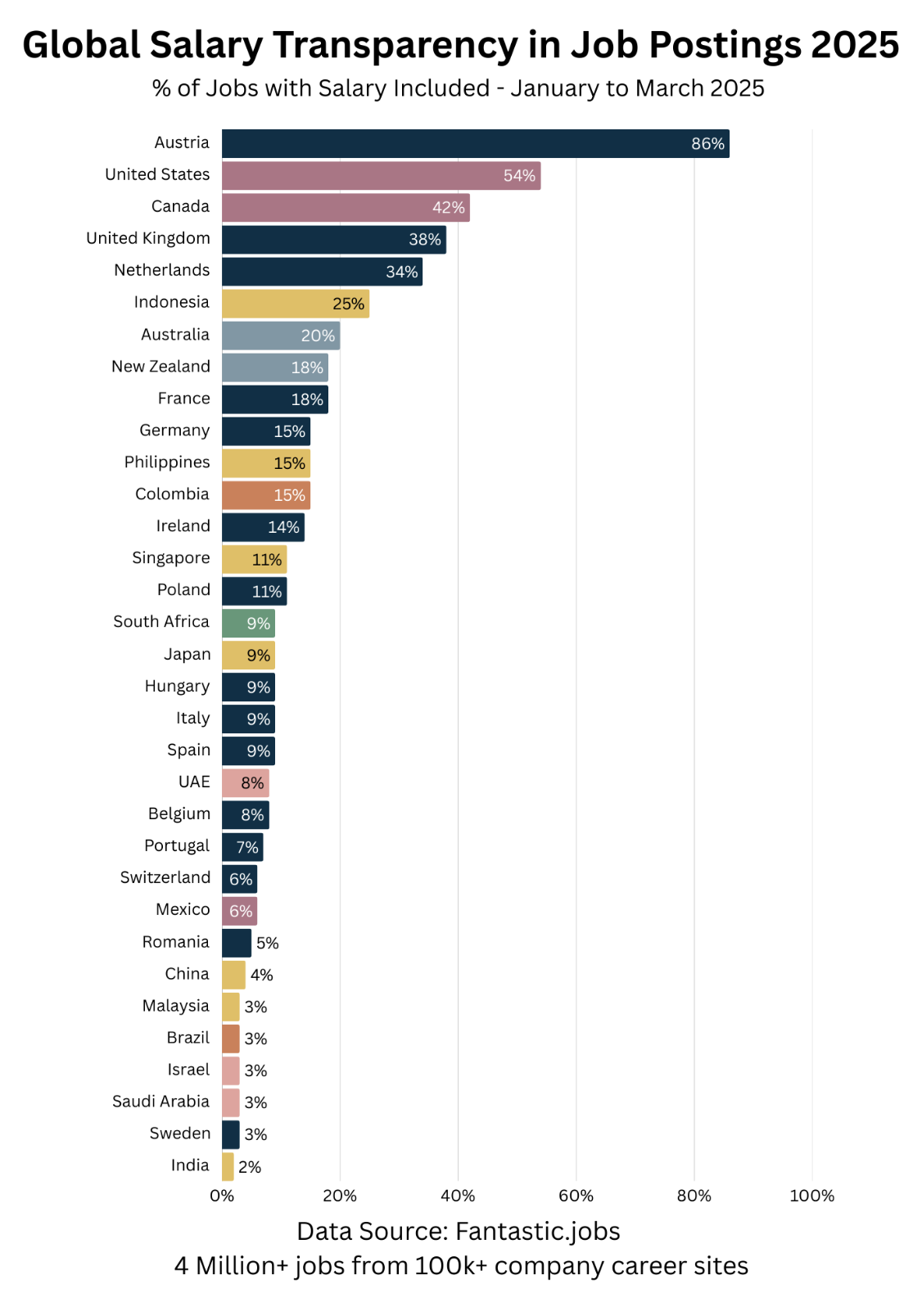
(To be clear: these figures represent the percentage of job postings that include the gross annual salary. So in Austria, 86% of job ads openly state how much the position pays.)
Italy and Spain? We're stuck at 9%.
That means only 9 out of 100 job postings actually say what they pay.
And that tells us a lot: in some countries, transparency is already the norm. In others (like Italy, Spain, and France) the EU Directive will represent a genuine cultural leap.
So, why does this regulation exist?
If your employees don't know what their colleagues earn, they can't assess whether their own compensation is fair.
They accept what's offered, with no basis for comparison.
And when they find out (often too late 🤦♂️ 🤦♀️) trust in the company is already gone.
Salary transparency changes the rules: it pushes organizations to build a compensation structure that is consistent, defensible, and based on clear criteria.
But there's another crucial issue that salary transparency directly affects: the gender pay gap.

The average Gender Pay Gap in the EU is still 12.0% (Eurostat 2023).
In other words: women earn on average 12% less than men for every hour worked.It's not a perception, it's a structural fact that has persisted for decades.
And it varies greatly from country to country: ranging from 0.9% in Luxembourg to 19.0% in Latvia. Almost 20 percentage points of difference.
Two ways to approach this transformation
As always, when facing regulatory change, companies have two options:
📌 Option 1: Passive compliance
Treating the regulation as a bureaucratic obligation.
"Okay, let's put a salary range in the job posting and hope nobody asks questions.
"The result? High costs, zero added value, and the risk of being unprepared when people start asking uncomfortable questions.
📌 Option 2: Strategic transformation
Using transparency as leverage to rethink the compensation system from scratch.
If salary becomes public, then you need an unassailable Job Grading system, where every salary difference is justified by objective criteria: skills, responsibilities, business impact.
This is the opportunity to build an organisation based on merit and skills, where salary growth is the natural consequence of professional growth.
What should companies (really) do?
Compliance is the starting point, not the finish line.If you want to transform this regulation into a competitive advantage, here's where to start.
1. Redesign Talent Acquisition ☑️
Think about this situation: you have two candidates with the same skills. One came from a company that paid little, the other from one that paid well. With the old system, the offers would have been different. From 2026, you can no longer do this.
Which forces you to do something you should have done long ago: define role pricing upfront, based on the value of the skills you need, not on the candidate's history.
2. Build a solid Job Grading architecture ☑️
Let's face it: answering the question "why do I earn less than my colleague?" is never simple. Not because companies act in bad faith, but because compensation systems have often been built over time, decision by decision, without a unified logic.
The Directive gives you the opportunity (and the obligation 😂) to put things in order.
You need a salary grid built on neutral and verifiable criteria: skills, responsibilities, business impact. Something that allows you to answer that question with data in hand, not with "it's always been this way historically."
3. Create clear growth paths ☑️
The right answer to "why does my colleague earn more?" isn't "because they're good."It's: "They've certified these skills, achieved these results, and that's why they're in the higher salary band. Here's what you should do to get there."
Without this clarity, transparency becomes a problem rather than an advantage.
4. Adopt a Data-Driven culture ☑️
The good news is that many compensation distortions are not intentional.
They accumulate over time, decision after decision, often without anyone really noticing.
That's why waiting until June 2026 is risky: not because sanctions will arrive, but because you might discover problems that could have been corrected much earlier, with much less effort.
Implementing People Analytics systems now allows you to monitor equity in real time, intercept distortions when they're still small, and manage change calmly, instead of chasing it.
5. Communicate, communicate, communicate ☑️
Think about how people in your company reacted when an important change arrived without warning.
Not well, right? 🤔
Pay transparency touches a sensitive topic: money.
And if people discover it by chance (from a job posting, from a colleague, from LinkedIn) they'll start off on the wrong foot.
HR professionals have the tools to avoid this: build internal communication that arrives first, that explains the why, and that transforms a regulatory obligation into something people perceive as an advantage for them.
Sounds easy, right? 😂 But we all know how hard internal communication actually is. The things worth doing, though, are never the simplest ones!
The (real) advantages of transparency
Okay, but why should you do all this work instead of just meeting minimum compliance?
Because transparency unlocks three enormous competitive advantages (supported by data):
🟢 Stronger Employer Branding
People today choose companies based on shared values.
According to the Indeed report (Indeed, 2023):
- 88% of HR decision makers say transparency makes it easier to attract candidates
- 95% of HR leaders say transparency has had a positive impact on the company brand
- Job postings with salary information receive approximately 30% more applications
An organisation that plays its cards on the table and guarantees equity and clear paths naturally attracts the best talent.

🟢 Greater organisational agility
If every skill is mapped and every person knows what they need to develop to grow, the organisation becomes more efficient.
Market needs change? You can quickly redeploy internal skills instead of hiring from scratch.
🟢 Higher retention and engagement
Transparency is the foundation of trust. And the numbers prove it:
- 82% of workers feel more engaged when paid fairly
- 81% feel more productive and loyal to their employer
- 93% of HR leaders who have implemented transparency say that the benefits outweigh the challenges
When an environment is perceived as fair, people stay, get involved, and seek growth from within.
The (understandable) fears and the reality
Before implementing transparency, HR leaders had concrete fears.
According to the Indeed report (Indeed, 2023), here's what they feared:
- 32% - "Overall salary costs will increase"
- 31% - "We'll expose our pay bands to competitors"
- 30% - "It will cause resentment and dissatisfaction"
- 28% - "It will make employees uncomfortable"
But after implementing it?
- 93% say the benefits outweigh the challenges
- 83% say it was "definitely" or "mostly" worth it.
This gap between fear and reality is significant.
Many companies feared the worst, but discovered that transparency improved the company climate, not worsened it.
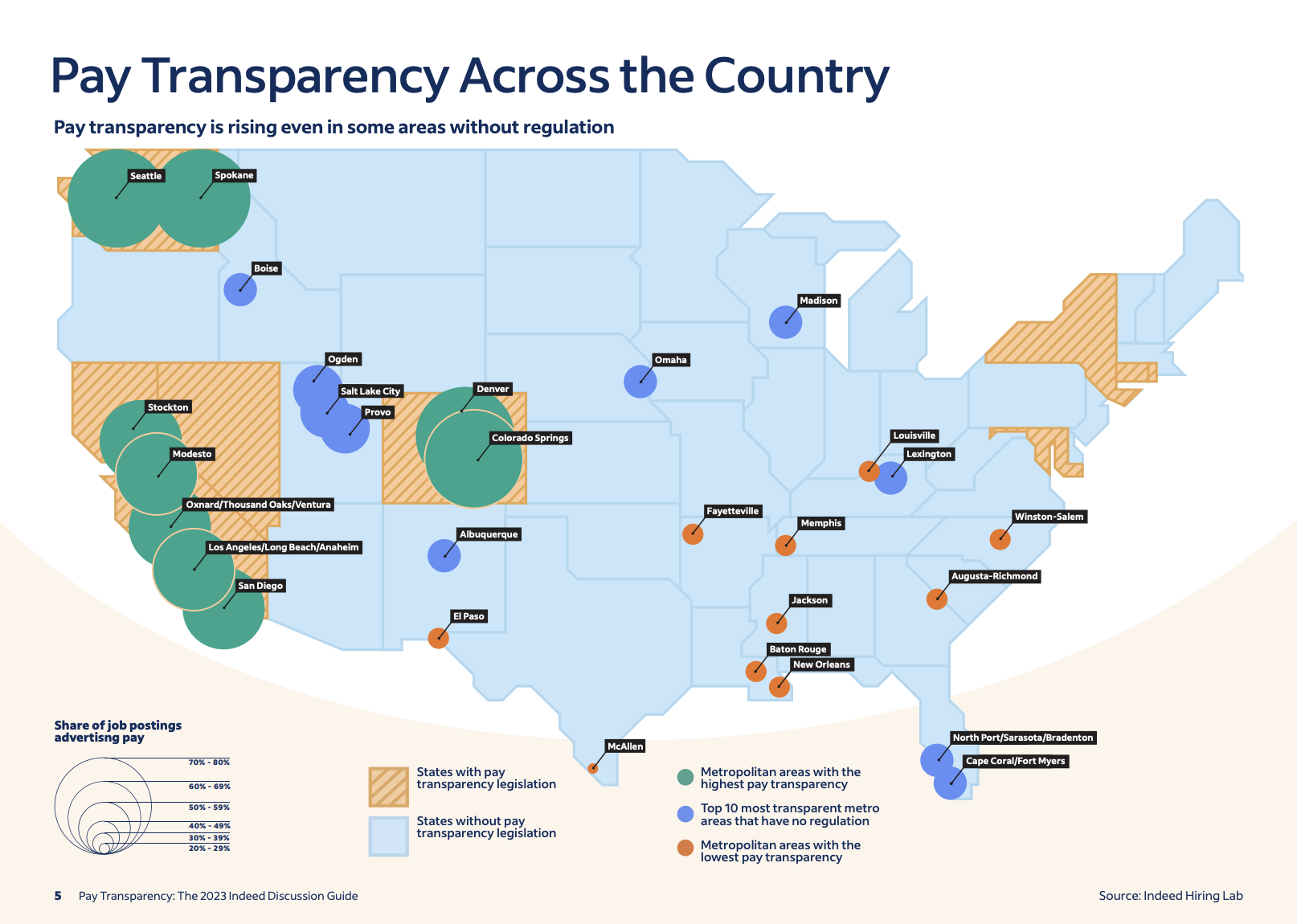
The uncomfortable truth
Let's face it: many companies in Europe are afraid of transparency.
Fear that inequalities will emerge.
Fear of difficult conversations.
Fear of losing "bargaining power."
It's understandable.
When the compensation system has been built over time, decision after decision, case after case, the idea of making it public can seem risky.
But that resistance often hides an opportunity: to finally build something clear, defensible, based on objective criteria.
The Directive is not a punishment. It's a push to do work that's worth doing.
And those who do it well find, on the other side, a more equitable, more agile, more attractive organization.
Our point of view
Pay transparency is not just about legal compliance.
It's a cultural paradigm shift.
For decades, compensation has been managed as a secret to be negotiated, often influenced by unconscious bias, power dynamics, and unwritten customs.
Now, the system is asking us to evolve.
To build organisations where a person's value is defined by the skills they bring, the impact they generate, and the results they achieve. Not by their salary history, not by their bargaining power, not by their ability to negotiate.
The companies that understand this today will be the ones that attract the best talent tomorrow.


Similar posts


Raison sociale : Pack Srl
Siège légal et domicile fiscal : Via Marconi 45, Bologne (BO) 40122, Italie
Code postal et TVA : IT04040451207
Code destinataire SDI : USAL8PV
Numéro d'inscription Imprese Registration : 04040451207


